
Playing the rarity bonus
A points game, not real-money betting. Uncle Predictor involves no money, accepts no deposits and awards no cash prizes. Nothing on this page is betting advice.
You earn extra points when you nail a scoreline few people dared to pick. The natural reaction on discovering this is to start writing strange scorelines everywhere — and it's the fastest way to finish last.
The trap
The bonus only exists if you get it right. A rare scoreline that doesn't happen is worth exactly the same as any other miss: zero. That's why the player who gambles on everything systematically ends up worse off than the one who never gambles — they lose their base points without ever reaching the prize.
The optimum isn't at either extreme. It's two or three deliberate deviations per matchday, chosen where you have concrete reasons, and consensus everywhere else.
Unlikely is not the same as unpopular
This is the distinction that separates people who use rarity well from people who just write nonsense.
- An unlikely scoreline rarely happens. 5-1, 0-4. Writing it down is betting against reality.
- An unpopular scoreline happens at a normal rate, but almost nobody writes it down. Writing it down is betting against other people's habits.
Only the second has value. And in the data from the 2026 World Cup — 104 matches, 4,305 predictions — the unpopular ones jump out:
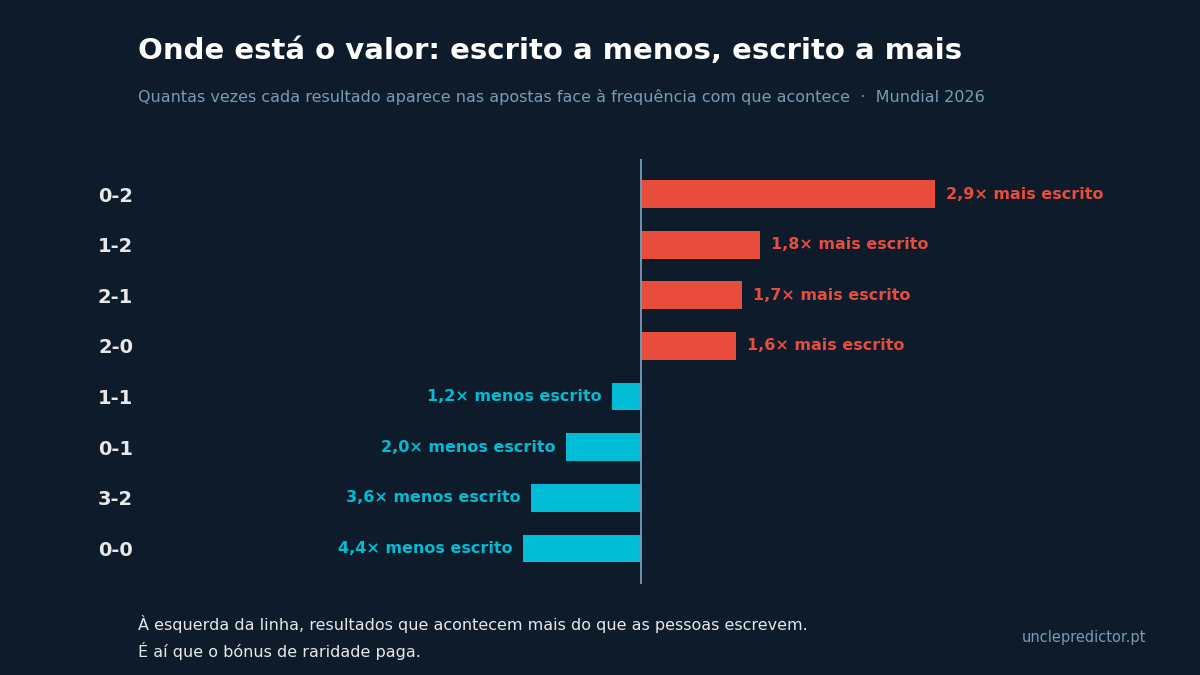
0-0 is the extreme case. It happened in eight of the 104 matches — the same eight as 2-0 — yet received 75 predictions against 536. There's nothing unlikely about it; it's just invisible. On the other side, 0-2 was written down almost three times more often than it actually happened.
The usual candidates
| Situation | Why it's undervalued |
|---|---|
| 0-0 in tight, cagey games | Writing 0-0 feels like admitting you know nothing about the match |
| Draw with a clear favourite | Anyone with an opinion feels obliged to pick a winner |
| Narrow win for the favourite (1-0) | People underestimate how much favourites struggle |
| Scorelines with three goals on the right side (3-2) | They happen more often than they seem to; almost nobody writes them down |
How to decide in practice
The useful question is not "what's the rarest scoreline?". It's this: given what I know about this match, is this scoreline more likely than the number of people who will write it down suggests? If the answer is yes, it's a good deviation. If it's "no idea, but it's rare", it isn't.
Two concrete signs that you're looking at a good candidate:
- You can explain the scoreline in one sentence — "this team hasn't scored away from home in six matches" — without mentioning luck.
- The obvious alternative scoreline is one goal away, so the near miss bonus still cushions you if you miss by a whisker.
How much to risk
It depends on the competition and your position. In a short tournament, risk is practically mandatory; in a long league, whoever never misses a matchday almost always wins. And near the end the rule flips depending on whether you're ahead or behind. It's all covered in long league or tournament.
Summary
- The bonus only exists if you get it right; gambling on everything is worse than never gambling.
- Look for unpopular scorelines, not unlikely ones.
- At the 2026 World Cup, 0-0 appeared 4.4× less often in predictions than in reality.
- Two or three deviations per matchday, with a concrete reason, and consensus everywhere else.
- Between two equally likely scorelines, the less popular one is always the better choice.
Data: 104 matches and 4,305 predictions from the 2026 World Cup recorded on Uncle Predictor, compiled on 9 August 2026.